


|
Bering
Mobile suit container
Bridge
Unit
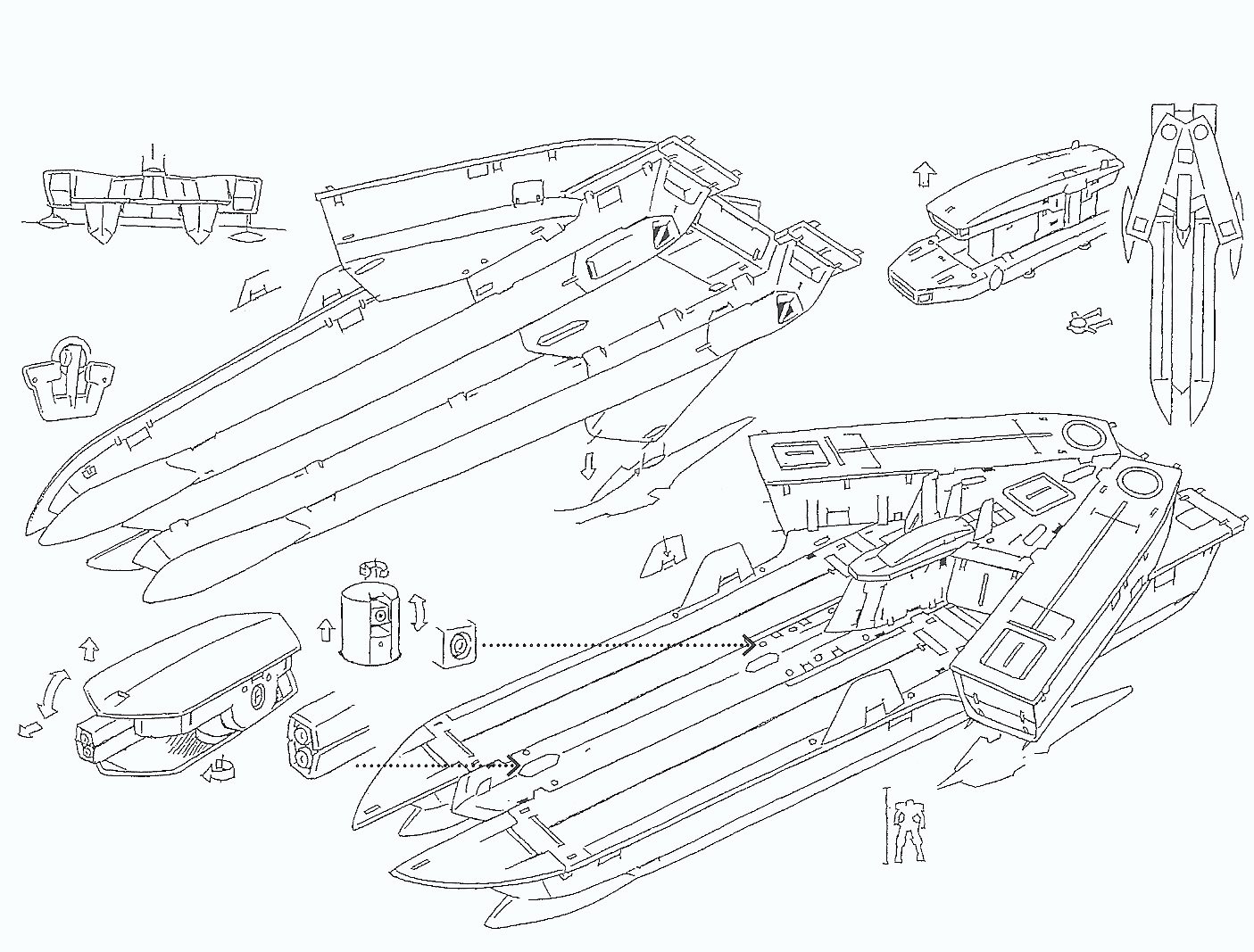
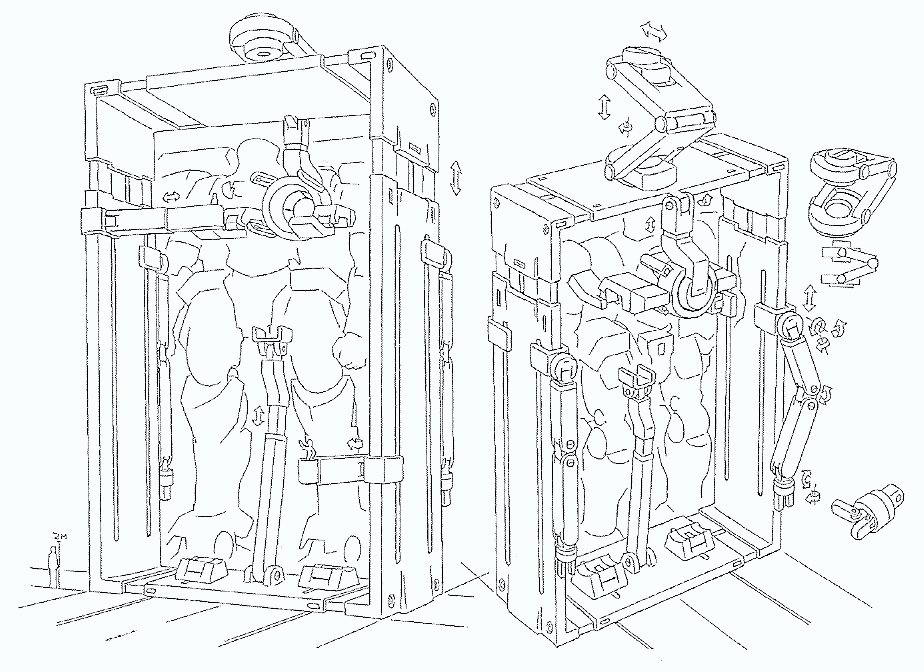
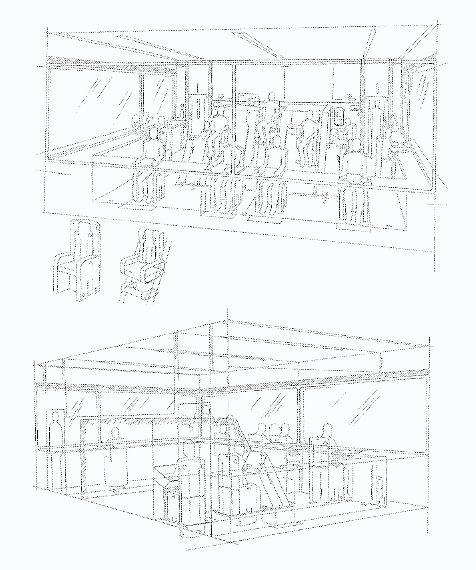
type: naval attack carrier In the early UC 240s there has been a growing incidence of attacks committed by trans-national terrorists, which has drawn considerable ire of Earth Union peacekeeping forces tasked with the elimination of such threats. As a result, there has been an increased interest in naval warfare systems as a means to interdict and apprehend wanted targets flying to different parts of the world to obtain weapons and other material. The Bering is the product of this renewed interest in what is by most descriptions a fairly antiquated concept. The twin-hulled design has a dagger-like profile with a fairly low displacement, giving it excellent speed and handling for a ship of its size. The entire bridge can be retracted into the aft superstructure during combat situations, and the vessel has not skimped on armor protection while likewise maintaining a smooth exterior that reduces its long-range sensor signature. Combined with its substantial armament and large mobile suit capacity, the Bering can act as a patrol vessel, mobile suit mothership, and heavily-armed battleship all at once, but to maintain this high mobility, a number of creative engineering efforts had to be made. Mobile suits are stored in large box-like hangars in the aft structure, allowing the hulls to be significantly narrower. They can be launched directly out of large doors that jut out beyond the beam of the main deck, or rolled out onto the decks for a catapult launch to speed up the deployment process. There are landing pads at the top of this structure and elevators are installed to allow mobile suits and other craft to be lowered into the hangar, keeping the forward decks free for launches. In order to quickly service mobile suits, a feature undoubtedly handy in counter-insurgency operations, the Bering employs a curious but effective system of mobile suit containers to store the units in its hangars. A rectangular frame, fixed to an overhead gantry and equipped with servo-actuated arms as well as a GN drive charging apparatus, is attached to each mobile suit and allows for rapid loadout adjustments and attachment of extra equipment. The containers can also be used to quickly shuttle mobile suits around within the hangars - unlike many other Union ships, its mobile weapons do not have to deploy in a given sequence. Additionally, the Bering takes account of the Earth Union's continued emphasis on mobile armors - there are two external mooring struts for Trilobites to dock to, and the forward decks have sufficient room for an Empruss or Regnant to land on with collapsible drive charging rigs to allow for a semi-continual deployment. To act as a primary warship, the Bering is well armed with five twin GN beam cannons that are taken directly from the Guyana-class battleship and installed on retractable mounts that lie flush with the deck. There are also numerous antiaircraft laser cannons positioned in similar mountings across the length of the vessel, while a vertically-oriented GN missile launcher is positioned aft of the main bridge, which can be used for air defense or antisubmarine purposes. Additionally, there are also four multi-purpose launchers clustered in the main deck; these non-GN weapons can be employed to fire flares or countermeasures as well as more exotic ordnance such as adhesive gel bombs, chemical tracking dyes, depth charges and mines, among others. This feature was specifically requested for its utility in asymetrical warfare where outright destruction of the enemy may not always be the most desireable course of action. |